


LoRaWAN and Smart Cities: a joint success story
Published: 16. Nov 2026
It’s ten years since the first issue of Smart & Easy was published. The ZENNER customer magazine went to press on 28 August 2016, and there have so far been over 20 further issues. The magazine came about as a result of the industry’s growing focus on digitalisation and marked the start of ZENNER’s realignment. The company has evolved from a meter manufacturer into a leading provider of smart, digital solutions for public utility companies, energy suppliers and water management applications.
Since its realignment, ZENNER has been focusing on developing smart solutions for the Internet of Things (IoT) based on the LoRaWAN open wireless standard. This technology had only just been developed in 2016, but it has now become firmly established and is widely regarded as a byword for digitalisation in the energy sector as well as in towns, cities and municipalities. That’s what makes this a joint success story.
Looking back is always interesting if it provides key insights for looking ahead. What has turned out differently than expected, and what strategies can now be derived from that for the future? Smart water is a good example. Whereas remote reading of water meters was still an isolated use case ten years ago, water is now a key element of cutting-edge smart city concepts and central to numerous use cases.
Development of smart cities
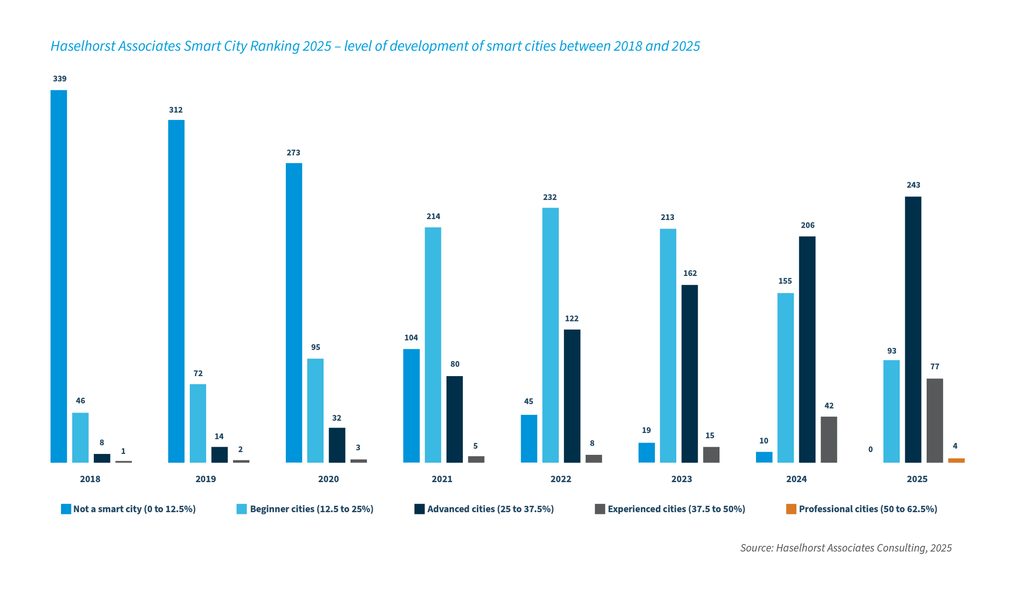
Germany’s towns and cities have undergone a significant transformation over the past decade, progressing from individual digitalisation projects to strategic smart city development. This is particularly evident from the annual surveys by Haselhorst Associates, which has been observing the development of more than 400 German towns and cities since 2018.
Whereas only 14 percent of the towns and cities in the survey were carrying out smart city projects back in 2018, they all were by 2025. Over 200 of them even have “advanced city” status.
René Claussen, Head of the Measurement Systems, IoT and Digital Solutions Business Unit at ZENNER, has been monitoring this process from the outset.
“Projects initially related to individual digital applications such as smart parking or smart waste, but the main focus now is on networked solutions for water, energy, climate protection and resilience. This shows that, in Germany, the smart city has gone from being a topic for the future to a municipal design task. Implementation remains challenging, though. The emphasis has now switched from individual flagship projects to a long-term strategy that combines digitalisation, sustainability and the needs of the public,” he explains.
On our website, you will find, amongst other things, the projects from Lünen and Altdorf.
A game-changer – LoRaWAN technology
When it comes to carrying out challenging smart city projects, LoRaWAN has without doubt become the number one basic technology over the past ten years and, over this same period, ZENNER has become the leading supplier of this technology. The Minol-ZENNER Group now operates one of the world’s biggest LoRaWAN networks, with around twelve million sensors. This energy-efficient wireless network enables cost-effective reading and networking of numerous sensors over long distances. For example, fill levels of waste containers can be monitored, the occupancy of car parks recorded, street lighting controlled, weather data evaluated, energy consumption analysed and data evaluated digitally. That gives towns and cities a reliable database for making more efficient use of resources, optimising processes and establishing new digital services.
Agile and resilient – the smart city
In smart cities, it’s particularly important for strategies and plans to remain agile so they can react flexibly to the latest developments and new conditions. Whereas the main focus a decade ago was on digital solutions to improve process and cost efficiency, topics relating to environmental and climate protection have increasingly come to the fore over time. Examples include saving energy, reducing CO2, developing climate-neutral building stocks, and monitoring air and water quality. What’s more, towns, cities and municipalities have been facing new challenges for a number of years now due to the consequences of climate change.
This demonstrates that changes can’t always be predicted and can quickly turn existing assumptions on their head. A flexible infrastructure based on LoRaWAN provides the necessary scope to make the most of opportunities, identify risks at an early stage, and react appropriately to new developments and challenges. This creates resilience at all levels.
Looking back to the future – water management
One of the earliest use cases, which we told our readers about in the very first issue of Smart & Easy, was the extensive automated remote reading of water meters using LoRaWAN®. This is the use case that is developing most dynamically right now. Climate change and frequent drought periods, even in Central Europe, and the resulting scarcity of water are presenting new challenges, including for municipal water utility companies. The goal is to prevent future water shortages by using water resources more efficiently and improving the protection of these resources. Towns, cities and municipalities need to adapt their infrastructure to safeguard the supply and quality of water over the long term. In other words, the water supply must become resilient.
In the water management context, resilience means water systems need to be resistant to climate change, extreme weather events, environmental pollution and other adverse effects. Digitalisation offers key tools and solutions. “With appropriate sensors and using LoRaWAN®, measurements can be transmitted directly to our B.One element suite platform and accessed by water utility companies. Our customers use the same method to transmit water meter readings and monitor their pipe networks for problems such as leaks. As a smart water solution provider, we supply appropriate applications for all process steps,” says Claussen. This example shows how LoRaWAN® can help turn individual use cases into complex, digital ecosystems. In this way, ZENNER is laying the foundations for further success stories.