

Smart Water Rollout: Five Steps to achieve a resilient water network
Published: 15. Jun 2026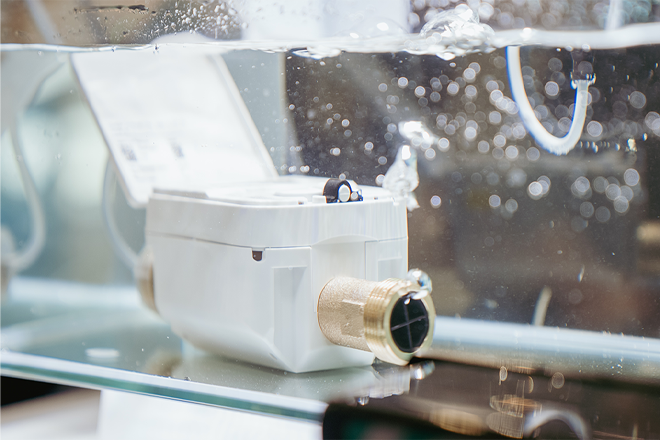
The water infrastructure is a key element in today’s cities, and the requirements relating to planning and operating the relevant networks are growing. Continuous monitoring of this infrastructure is becoming an important prerequisite for futureproof network operation. The focus is on the principle of resilience. Besides offering a high level of performance, infrastructure also needs to be resistant and robust.
LoRaWAN® has established itself as a trailblazing technology for public utility companies and water management. This radio standard offers cities genuine added value by cost-effectively networking thousands of sensors and devices over a large area. The technology combines long-range capabilities with very low power consumption. All relevant data from the water infrastructure is made continuously available via the Internet of Things (IoT). Measurement technology, sensors and communication infrastructure create the basis for resilient water infrastructures and the smart water rollout.
“The digitalisation of utility companies is no longer merely a ‘nice-to-have’, but rather the foundation for true smart city resilience. IoT solutions with LoRaWAN® are all but essential for smart cities,”
emphasises Jan-Philipp Exner, a smart city expert at ZENNER.
Step 1: Water and level monitoring
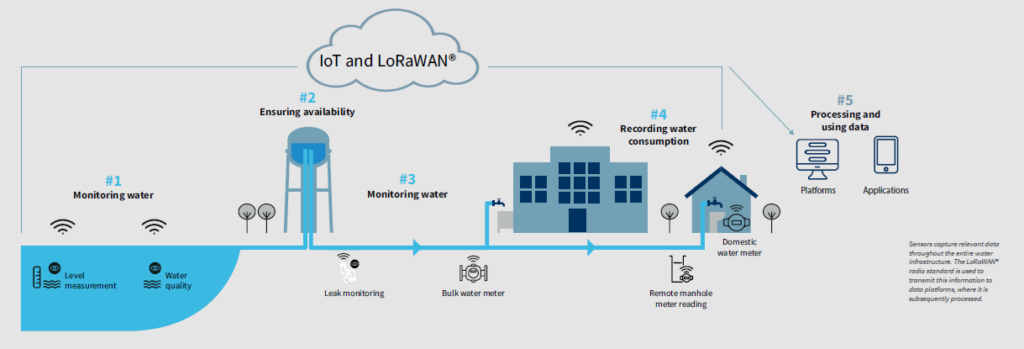
Natural water resources such as rivers, lakes and groundwater form the basis of the supply system. Extreme weather events such as heavy rainfall can lead to very high water levels and overflowing rivers. Failure to detect such situations promptly brings with it the threat of substantial damage. LoRaWAN®-based level monitoring automatically captures water levels and transfers this data to the relevant authorities. What’s more, additional sensors can be used to ascertain groundwater levels and check water quality. Status updates and warnings help public utility companies and municipal departments take immediate action. This reliably ensures the water fed into the drinking water network is clean.
Step 2: Reliably ensuring availability
A drinking water reservoir located between the source and the distribution network balances out fluctuations in consumption and ensures a continuous supply for the downstream pipe network.
Step 3: Resilient water networks
Germany’s drinking water pipe network has a total length of over 530,000 kilometres. Due to network losses, some 126 billion cubic metres of drinking water is lost worldwide each year. The figure for Germany is just under 235 million cubic metres. Intelligent monitoring locates leaks and abnormalities soon after they occur, reduces water losses and creates a pool of data for targeted maintenance work. To help water utility companies, ZENNER entered into a partnership with FAST GmbH in April 2025 with the shared goal of developing an adaptive solution for digital water network monitoring that is the ideal addition to the existing LoRaWAN® network.
Step 4: Recording consumption
Today’s water meters are much more than just measuring devices. ZENNER’s IUWS B.One ultrasonic domestic water meter is based on over 100 years of experience in developing water meters. Equipped with a “parallel radio” function, this meter transmits measurement data via LoRaWAN® and Wireless M-Bus simultaneously. It also detects leaks and automatically raises the alarm. As a result, the role of the traditional water meter is changing. It is no longer merely being used to record consumption and is instead becoming part of the digital smart water infrastructure.
Step 5: Data platforms and apps
To get the most out of data, it must be usable. ZENNER’s B.One element suite platform compiles and evaluates all measurement data from the water infrastructure and visualises it in real time. This opens up a wide range of possible uses, including submetering, leak detection, network monitoring and variable water tariffs. Looking ahead, new communication options may also be possible, such as providing members of the public with specific information via a dashboard or app. To help water utility companies worldwide get started with data logging based on radio transmissions, ZENNER has developed a solution package called B.One Metering as a Service (MaaS). The MaaS app visualises key meter, alarm and consumption data.
“With the incorporation of further sensors, MaaS can be used to create sustainable and resilient water systems and even integrate flood protection solutions,” explains René Claussen, Head of Business Unit Measurement Systems, IoT and Digital Solutions at ZENNER.
The interaction of measurement technology, infrastructure and data platforms paves the way for the smart water rollout and the creation of resilient water management infrastructure. Consumption is easier to plan, resources can be used and safeguarded in a more targeted way, and potential bottlenecks can be identified early on.
“Smart metering and digital platforms are becoming increasingly important in water management. We take a holistic approach to digitalising water management. As we see it, a smart water rollout goes beyond the digitalised, automated recording of measurements and also covers complementary IoT solutions that make it possible to operate our networks reliably.”
René Claussen, Head of Business Unit Measurement Systems, IoT and Digital Solutions at ZENNER
Smart water solutions with ZENNER
The digitalisation of water management is becoming increasingly important. From communication infrastructure, measurement technology and sensor technology through to the associated software, ZENNER provides everything from a single source. This makes it possible to implement a whole host of smart water solutions:
Water monitoring: Intelligent level monitoring with LoRaWAN®
The consequences of climate change are becoming increasingly apparent and call for new solutions. Monitoring to detect and report imminent risks – resulting from flooding, for instance – is particularly lacking at critical locations. LoRaWAN®-based monitoring uses sensors to automatically capture water levels and transfer this data to the relevant authorities via a data platform such as ZENNER’s B.One element iot. Public utility companies, the fire service and Germany’s Federal Agency for Technical Relief (THW) automatically receive status updates and warnings and can act immediately.
Leak detection in buildings
Leaks and burst pipes in water networks often go undetected for long periods. In most cases, damage to buildings is very costly and can increase water consumption. Smart leak detection involves networking a LoRaWAN®-enabled water meter with a smart valve. If the back-end system detects that a preset maximum flow value is being breached, the platform sends a signal to the smart valve, which then automatically closes and stops the flow of water.
Using IoT sensors to monitor water quality
Manual monitoring of the water quality in bodies of water and reservoirs is a costly and labour-intensive process. Intelligent IoT sensors significantly reduce the outlay involved. They continuously and reliably measure parameters such as conductivity, temperature, water level, dissolved oxygen, pH and nitrate content. If specific limit values are exceeded, the relevant authorities are automatically alerted.
Intelligent remote reading of underground meters with LoRaWAN®
The manual reading of underground meters regularly poses challenges for water utility companies, as it is costly and also very time-consuming for the staff involved. LoRaWAN® puts an end to this laborious process by offering an easy and reliable way of obtaining readings from water meters, other measuring equipment and sensors installed in locations that are difficult or impossible to access. The meter data can be viewed at any time – including remotely – and is then available online for further processing on ZENNER’s B.One element suite platform.
Multi-utility readout of consumption meters
The multi-utility readout function enables automatic remote reading of water, gas and heat meters via an IoT gateway (e.g. via LoRaWAN®). Besides eliminating the need for manual readings, the scheduling of these readings and multiple visits, this also improves efficiency and the quality of data. What’s more, consumption data can be processed centrally and used for energy monitoring or billing purposes – a key factor for digitalised, cost-efficient supply networks.
Intelligent pipe network monitoring with LoRaWAN®
By using smart water meters, utility companies can make the water network more transparent in terms of flow and consumption profiles. Moreover, modular LoRaWAN® sensor technology ensures acoustic analysis processes can be used to pinpoint the location of characteristic noises made by leaks in the pipe network.
Smart water solutions support various goals,
including the following UN SDGs: